



An AI observability platform applies AI to observability data (metrics, logs and traces) so that teams can detect problems, understand why they happened and, increasingly, act on what they find. Until recently, observability meant collecting data and watching system health. Adding AI has changed the question buyers ask. It is no longer whether a platform "has AI," but how far that AI actually goes: does it only tidy up alerts, does it explain failures, or does it take part in the work of operating the system?
In 2026, the answer tends to fall into one of three levels: intelligent alert correlation, AI-powered root cause analysis, and AI Agent operations. Each level solves a different problem, and each asks something different of your team. Bonree ONE is built to cover all three. It combines intelligent monitoring and AI root cause analysis with Bonree ONE·Sage AI, an AI Agent operations workspace for diagnosis, analysis and custom operational workflows.
This article walks through those three levels, shows how Bonree ONE, Dynatrace, Datadog and Splunk position themselves on each, and offers a practical way to judge whether an AI platform can be trusted. It does not rank vendors. Its goal is to help you work out which level of capability your own operations need.
Disclosure: this comparison is published by Bonree, the maker of Bonree ONE. Bonree information comes from Bonree's public materials; information about other vendors comes from their public documentation and product pages. Vendors update their products often, so please verify current capabilities with each vendor directly.
Three levels, three different problems
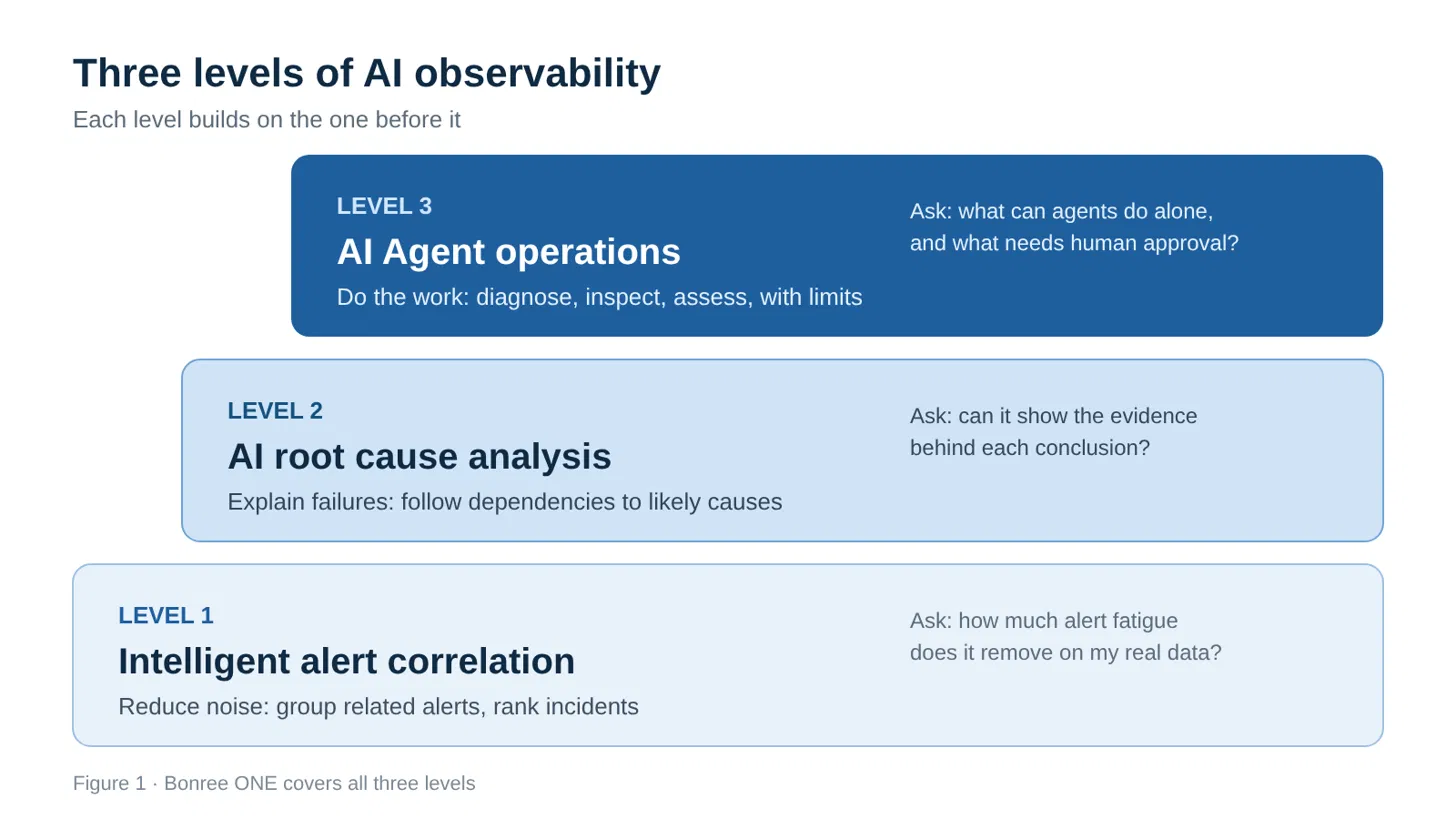
Figure 1. Each level builds on the one before it: from reducing noise, to explaining failures, to carrying out operational work.
The first level is intelligent alert correlation. Large environments produce more alerts than any team can read, and many of them describe the same underlying event. At this level, AI groups related alerts, spots anomalies and ranks incidents so that people see a short list instead of a flood. The question to ask is simple: on your real operational data, how much does the platform actually reduce alert fatigue?
The second level is AI root cause analysis. Knowing that an incident is important is not the same as knowing where it started. Here, AI looks at how services, infrastructure and recent changes depend on one another and proposes likely causes. The thing to test is explainability. A suggested cause is only useful if the platform can show the evidence behind it, so that an engineer can check the reasoning rather than take it on faith.
The third level is AI Agent operations. Instead of stopping at analysis, AI Agents help carry out the work around it: diagnosing an incident across several steps, inspecting system health, analyzing a database, assessing capacity or weighing the risk of a change. Because agents can do more, the key question shifts from "what can they find?" to "what are they allowed to do on their own, and what needs a person's approval?" A dependable agent system needs clear boundaries, a record of what it did, decisions that can be explained, and a human who stays in control.
How four vendors position themselves
All four platforms discussed here offer something at each level, which is why a feature checklist tells you little. The differences show up in emphasis and in how much autonomy each one describes. The table summarizes what each vendor says publicly.
Platform | Intelligent alert correlation | AI root cause analysis | AI Agent operations |
Bonree ONE | Intelligent alerting, anomaly detection and prediction | AI-based root cause analysis built on entity relationships and knowledge graph approaches | Bonree ONE·Sage AI provides AI Agents for incident diagnosis, database performance analysis, health inspection, capacity assessment and change risk analysis, plus custom Agent creation |
Dynatrace | Dynatrace Intelligence offers out-of-the-box anomaly detection and forecasting | Dynatrace Intelligence is powered by Dynatrace causal AI, the Grail data lakehouse and the Smartscape real-time dependency graph | Positioned as an agentic operations system, with domain agents for areas such as SRE, security and business observability, and agentic workflows with policy-driven controls and approvals |
Datadog | Watchdog is Datadog's AI engine for automated alerts, insights and root cause analyses; it learns normal behavior to flag unusual activity | Bits AI SRE (also called Bits Investigation) investigates alerts and surfaces likely root causes, using the same telemetry as the team, an understanding of the architecture, and the team's runbooks | Bits AI SRE is described as an autonomous SRE agent that investigates alerts the moment they trigger; Datadog also shows investigations running inside workflows and custom agents built with Agent Builder. Per its documentation, one-click infrastructure actions (Preview) run only when the user clicks Run, and guardrail levels such as "Ask" require user approval |
Splunk (Cisco) | Event iQ in Splunk IT Service Intelligence uses machine learning to group related alerts into episodes | The AI troubleshooting agent in Splunk Observability Cloud investigates alerts using logs, traces and other evidence, and shows suspected root causes with confidence levels | AI SRE is described as an agent teammate that correlates related alerts into incidents, investigates and generates step-by-step remediation plans; Splunk states it does not automatically execute fixes and relies on engineers to review, approve and carry out the final steps |
Read across the third column and a pattern appears. Dynatrace, Splunk and Datadog all describe some form of approval or control around agent actions, though they differ in how and where. Datadog also emphasizes an agent that starts investigating the moment an alert fires. Bonree ONE takes a scenario-first route: Sage AI ships agents for common jobs such as incident diagnosis and database analysis, and lets teams build their own for workflows we could not anticipate. None of these is automatically better. Which one fits depends on how much autonomy your team is comfortable handing over, and on which tasks you most want help with.
One caution on root cause analysis. "AI root cause analysis" is not a single technique, and it is not always the same thing as causal AI. Some platforms emphasize causal models and dependency graphs, while others rely on knowledge graphs, statistical methods or AI-driven reasoning. Since the label hides these differences, the most reliable comparison is to run each platform against your own incidents.
How Bonree approaches it
Bonree ONE builds its AI features on a single data model centered on entity relationships: services, hosts, databases and the links between them. Collecting data in that shape makes it possible to follow relationships during an investigation instead of treating each signal in isolation, and it gives root cause analysis something concrete to reason over.
Sage AI sits on top of that foundation and extends it into agent operations. Through MCP integration, Skills and multi-agent orchestration, teams can assemble AI-driven workflows for their own scenarios, from incident diagnosis, database analysis and health inspection to capacity analysis, change risk assessment and fully custom agents. The aim is not to replace engineers. It is to make it faster to understand a complicated environment, narrow down a failure and decide what to do next.
How to tell whether an AI platform can be trusted
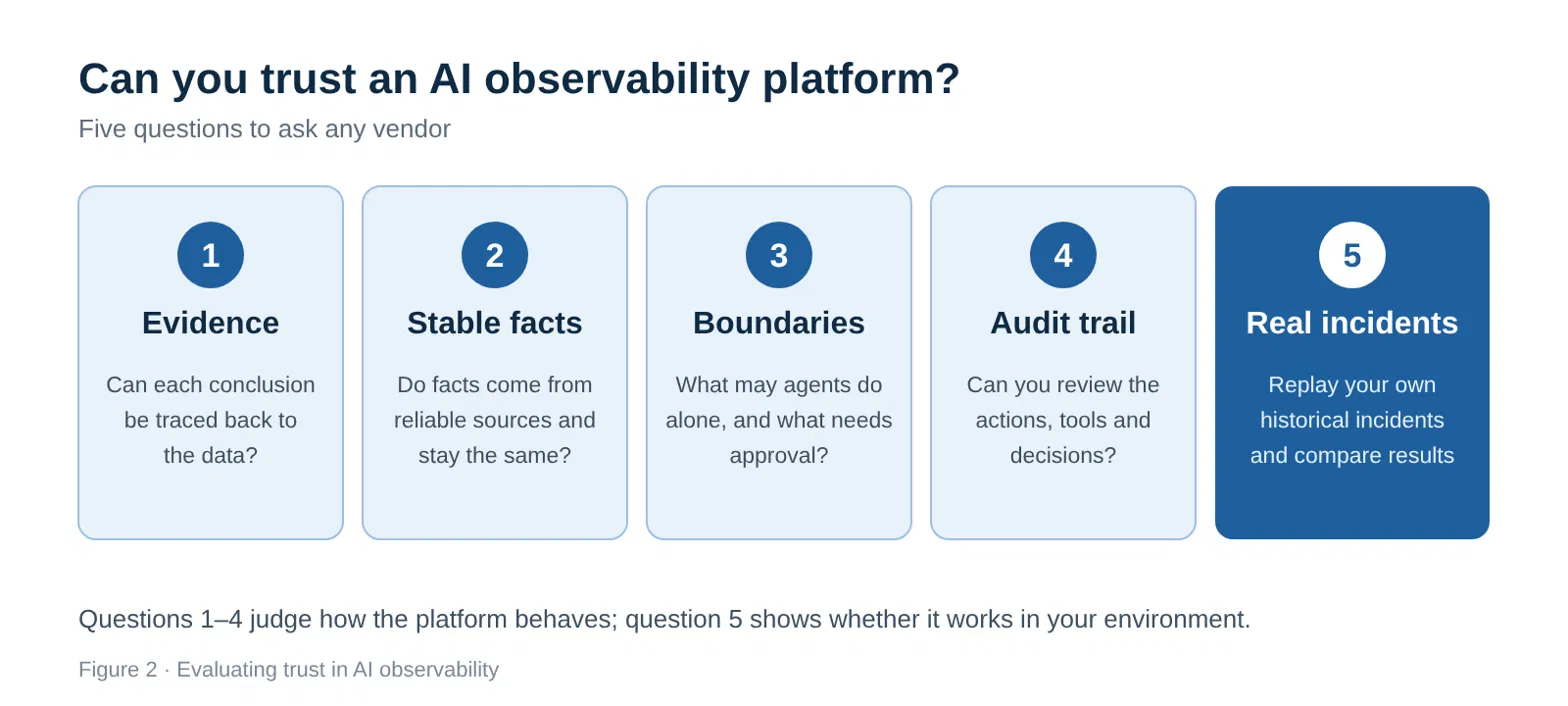
Figure 2. Five questions to put to any AI observability platform, whichever vendor it comes from.
As AI takes on more of the work in IT operations, trust becomes the deciding factor. Five questions are a good place to start.
The first is about evidence: can every conclusion be traced back to the observability data behind it? A second, related question concerns deterministic data. The facts an AI works from should come from reliable sources and stay the same each time you ask. The model's reasoning may vary a little from run to run, but the evidence it relies on should not.
The third question is about operational boundaries. You should know which actions an agent may take alone and which need approval before they happen. The fourth is auditability: can your team look back at what the agent did, which tools it used, how the investigation unfolded and why it reached its decisions?
The fifth is the most practical of all: test it on real incidents. Replay historical incidents from your own environment and see whether the platform finds the cause, shows its evidence and stays within its limits. Beyond that, look at data coverage, root cause accuracy, explainability, agent capabilities and security controls.
Which level fits your team
If your main pain is alert overload, your incident patterns are fairly predictable and what you mostly need is faster prioritization, intelligent alert correlation may be all you need.
If your applications are highly distributed, and engineers lose hours tracing a failure through layers of dependencies, AI root cause analysis is the more natural goal.
AI Agent operations makes sense once your team has repetitive operational tasks, incidents that take several steps to investigate, a wish for AI help with diagnosis and analysis, and clearly defined limits on what automation may do.
If you are ready to go beyond alert correlation, Bonree ONE covers all three levels in one platform. Bonree ONE·Sage AI lets teams start from ready-made scenario Agents, such as incident diagnosis or database analysis, and then build custom Agents for their own workflows. A good first step is to test it against your own historical incidents.
FAQ
What is an AI observability platform?
It is a platform that applies AI to observability data to help organizations detect issues, understand root causes and improve operational efficiency.
What is the difference between AI observability and AIOps?
AIOps applies AI to IT operations, including alert management, anomaly detection and automation. AI observability widens that scope by combining observability data, AI analysis and Agent-based operational capabilities.
What is an AI Agent operations platform?
It is a platform where AI Agents investigate issues, analyze data and assist with operational workflows within the permissions they have been given.
Is AI root cause analysis the same as causal AI?
Not necessarily. Vendors use different approaches: some emphasize causal models and dependency analysis, others use knowledge graphs, statistical methods or AI-driven reasoning. Evaluate the results against your own operational scenarios.
Does Bonree ONE provide AI observability capabilities?
Yes. Bonree ONE combines intelligent observability, AI root cause analysis and Bonree ONE·Sage AI, an AI Agent operations workspace designed for intelligent diagnosis, analysis and operational workflows.
How can organizations evaluate AI observability platforms?
Look at data coverage, root cause accuracy, explainability, agent capabilities, security controls and auditability, and test them on historical incidents from your own environment.
About Bonree
Bonree (Bonree Data Technology Co., Ltd.) develops Bonree ONE, an AI-driven observability platform designed to help enterprises monitor, analyze and optimize complex digital environments. With Bonree ONE·Sage AI, organizations can extend observability capabilities into AI Agent operations, enabling intelligent diagnosis, analysis and customized operational workflows.