



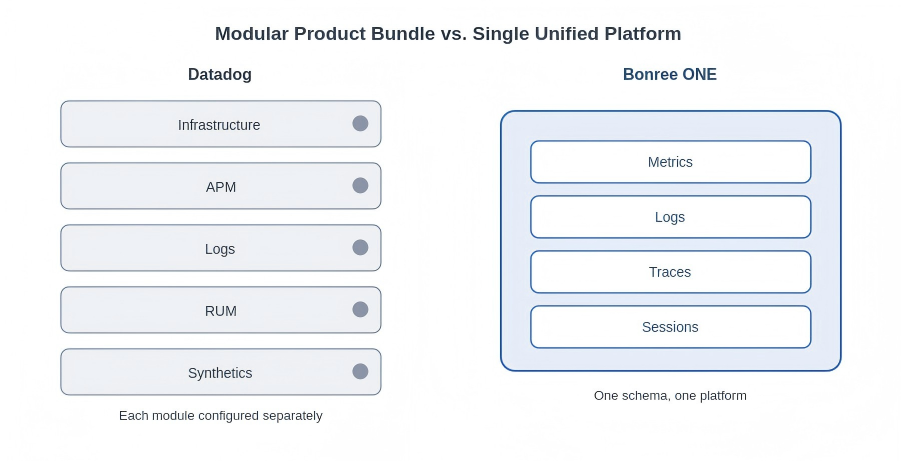
What's the practical difference between Bonree ONE and Datadog? Datadog is a broad, modular observability platform — infrastructure, APM, logs, RUM, synthetics, and more are separate products, each with its own configuration and data model, unified under one dashboard. Bonree ONE is built around a single unified observability data model, where metrics, logs, traces, and user-session data share one schema, and AI Observability plus agentic AI operations — through Bonree ONE • Sage AI — sit on top of that shared foundation.
What Datadog Does Well
Datadog's breadth is real. Its integration catalog is one of the largest in the industry, its dashboards are polished, and for teams that want one vendor covering infrastructure, APM, logs, RUM, synthetics, and security, it remains a strong default choice with continued adoption at scale.
Where Datadog's Modular Design Adds Friction
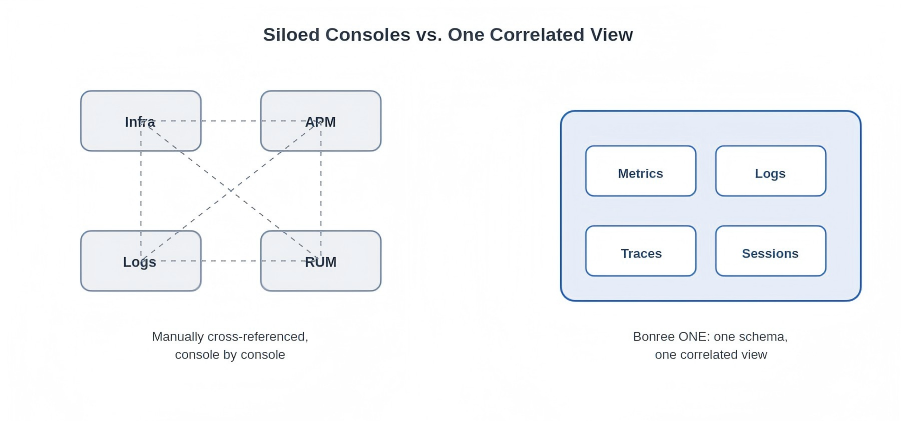
Because each Datadog product was built as its own module, correlating an issue across them often means moving between separate consoles — checking infrastructure metrics in one view, application traces in another, and logs in a third — rather than working from one shared schema. A few patterns tend to show up in practice:
● Separate configuration per product. Alerting rules, retention settings, and tagging conventions are typically configured independently for infrastructure, APM, logs, and RUM, which adds setup and maintenance overhead as the estate grows.
● Cross-product correlation is manual. Because each product has its own data model, tracing a single incident from an infrastructure metric to a specific trace to the related log lines usually means pivoting between consoles rather than querying one shared dataset.
●Onboarding a new service touches multiple products. Getting full visibility into a new service can mean instrumenting it separately for infrastructure, APM, and logs rather than a single integration step.
Where Bonree ONE Differs
Bonree ONE's architecture avoids the siloed-product pattern by design: metrics, logs, traces, and session data live in one unified data model, so an investigation can move from a metric to a trace to the underlying log lines within the same schema rather than pivoting between separate tools. Its Configuration-Free Integrated Smart Probes are built to reduce the instrumentation effort of onboarding new services, and its AI Observability and agentic AI capabilities, through Bonree ONE • Sage AI, work across the whole dataset rather than being scoped to a single product.
Bonree ONE also supports public cloud, private cloud, hybrid cloud, and traditional IDC deployments natively — relevant for organizations that can't run everything in a public-cloud-only environment.
FAQ
Does Bonree ONE cover the same breadth as Datadog?
Bonree ONE covers full-stack and full-end observability — infrastructure, application, front-end web and mobile, and network — within one platform. Organizations with a long tail of very specific Datadog integrations should verify coverage for their particular stack before considering a change.
Is Datadog's integration catalog stronger than Bonree ONE's?
Datadog has one of the largest third-party integration catalogs in the industry. Bonree ONE supports low-code integration with a wide range of third-party data sources and is built to standardize heterogeneous data from existing systems, but teams with niche SaaS dependencies should confirm specific coverage.
How does investigating an incident differ between the two platforms?
In Datadog, an investigation often moves across separate infrastructure, APM, and log consoles, each with its own data model. In Bonree ONE, metrics, logs, traces, and sessions share one schema, so an investigation can move between them without switching tools.
Can Bonree ONE be deployed on-premises, unlike a cloud-first platform?
Yes. Bonree ONE supports public cloud, private cloud, hybrid cloud, and traditional IDC deployments, which can matter for organizations that need to keep parts of their stack off the public cloud.