





When does it make sense to consider migrating off Datadog for cost reasons? Typically, when the bill has stopped tracking the size of the environment and started tracking usage spikes and product sprawl instead. Datadog's own published billing mechanics — combined with common FinOps commentary on usage-based observability pricing — point to a recurring pattern: teams that don't actively manage host peaks, log indexing volume, and add-on modules can see actual spend drift meaningfully above their original sizing estimate over time.
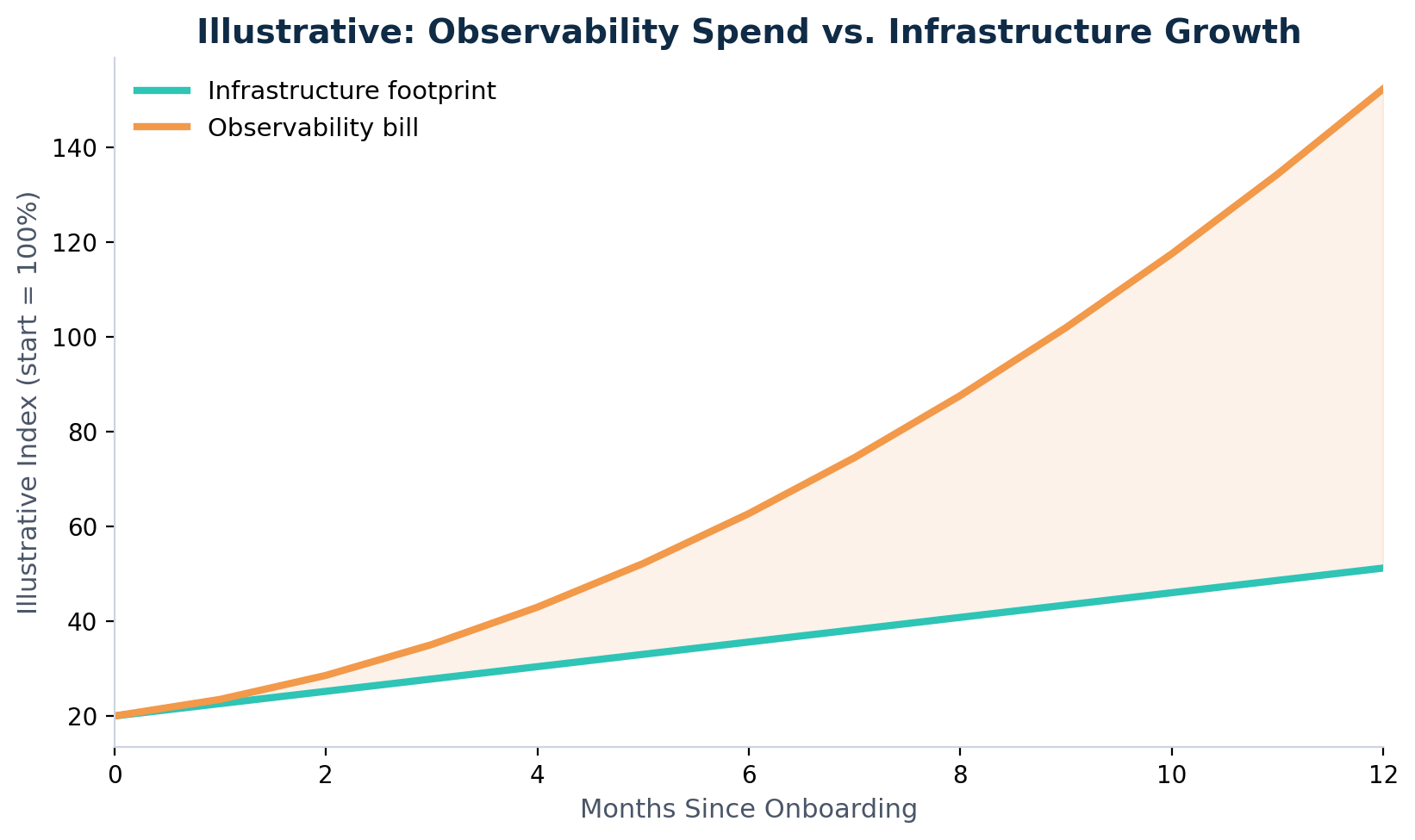
Audit Before You Migrate: Where the Money Actually Goes
Before evaluating any alternative, it's worth breaking down which billing mechanics are driving the current bill, because the fix is different for each one:
High-water-mark host billing. Host count is metered on a rolling basis and billed against a peak usage figure for the month. A short autoscaling event can influence pricing for the entire billing period even if it lasted only a few days.
Log ingestion vs. indexing. Ingestion is typically inexpensive; indexing — what makes logs searchable — costs meaningfully more. Teams that route everything to indexed storage by default can end up paying to search logs they rarely query.
APM tied to infrastructure licensing. On Datadog's published pricing structure, APM is generally sold alongside an Infrastructure license rather than as a fully standalone product, which means an instrumented host often carries more than one associated charge.
Add-on sprawl. Modules such as Database Monitoring or Cloud Cost Management each introduce their own separate meter on top of the base products.
Quantifying each of these separately — not just looking at the total bill — helps clarify whether the real fix is a pricing renegotiation, a data-volume reduction, or a full platform migration.
What a Migration Actually Requires
A cost-driven migration only succeeds if it doesn't recreate the same visibility gaps somewhere else. A practical checklist:
Inventory current instrumentation. List every host, service, and log source currently sending data to Datadog, and which dashboards or alerts depend on that data — this becomes the acceptance test for the new platform.
Prioritize by monitoring criticality, not by ease of migration. Migrate the services where losing visibility for even a day is unacceptable last, once the new platform's alerting and dashboards have been validated against real production traffic on lower-priority services.
Re-evaluate what actually needs to be indexed. A cost-reduction migration is a natural point to separate logs that need to be searchable in real time from logs that only need to be retained for compliance or occasional lookup.
Run both platforms in parallel briefly. A short overlap period where both the old and new platform receive the same data is a reliable way to help confirm alert parity before fully cutting over.
What to Look for in the Destination Platform
A meaningful part of Datadog's cost unpredictability comes from its architecture: separately metered products (hosts, APM, logs, RUM, synthetics) each add their own billing dimension. A platform built around a single unified data model — where metrics, logs, traces, and session data share one schema rather than being priced as separate products — can help avoid recreating that same multiplying-meters problem after migration.
Bonree ONE's SmartAgent auto-instrumentation is designed to reduce the manual configuration effort that migrations typically require, and its unified observability data model keeps metrics, logs, and traces correlated within a single platform. It also layers AI Observability and agentic AI operations, through Bonree ONE • Sage AI, on top of that shared data model. Because Bonree ONE pricing is quote-based rather than a published per-unit rate card, a good first step for a cost-driven evaluation is a quote scoped against your actual current usage — host counts, log volume, and span volume — so the comparison is closer to apples-to-apples rather than headline-price-to-headline-price.
FAQ
Is a Datadog cost problem usually a pricing issue or a usage issue?
Often both, but usage patterns — indexing more logs than are actually searched, or letting autoscaling spikes set the host-billing baseline for the month — tend to be the larger and more fixable driver, which is why an audit should come before any migration decision.
How long does a typical cost-driven observability migration take?
It depends on environment size, but a phased approach — inventory, parallel run on lower-priority services, validation, then migration of critical services last — is generally safer than a single cutover, and most organizations should budget for a multi-week overlap period.
Will migrating off Datadog mean losing integrations we depend on?
Possibly, for niche or highly specific third-party integrations. Verifying integration coverage for your specific stack — not just the size of a vendor's general integration catalog — should be part of the pre-migration inventory.
Does Bonree ONE avoid the per-product billing pattern that can make Datadog bills harder to predict?
Bonree ONE's unified data model keeps metrics, logs, traces, and sessions in one platform rather than separately metered products, and pricing is quote-based against your actual deployment scope rather than per-host, per-product rate cards.