



The Bonree Academy livestream series focuses on hands-on observability scenarios. Built around the Bonree ONE intelligent observability platform, it covers four practical scenarios: data integration and governance, AI operations agent building, compute cost control, and database observability. This article offers a technical walkthrough of the livestream “AI Operations Agent Building: Creating an Operations Agent from Scratch.”
The Bonree ONE · Sage AI agent workbench is far more than a chat tool. It is a mechanism built on “resource orchestration + capability reuse.” Operations experience is first packaged into a standard form, then delivered through a unified agent for daily inspection, diagnosis, and Q&A. Operations capabilities become configurable, reusable, and schedulable, helping business systems run stably, efficiently, and continuously.
The livestream demonstrated, end to end, how to build a “Database Call Inspection Expert” agent and use it to run a real database call inspection. You can see how an operations agent moves from resource readiness to capability orchestration to publishing, and is finally invoked by the business side in Bonree ONE · Sage AI. You can also see how operations experience evolves from an individual skill into a configurable, reusable organizational capability.
The Core Pain Point in Enterprise Operations: The Problem Isn’t Too Few Tools, but Experience That Can’t Be Reused
Enterprise operations work depends heavily on experience. A senior engineer’s inspection instincts, fault-judgment skills, and SQL analysis ability are hard to standardize and pass on. Teams evolve independently, each with its own inspection procedures, threshold standards, and report formats.
In practice, the core bottleneck is not insufficient tool coverage but three structural conflicts:
Inconsistent capabilities: The same inspection task produces uneven quality depending on who performs it, and reports come in all shapes.
Experience that doesn’t accumulate: When a senior DBA leaves, years of accumulated inspection experience and judgment logic leave with them.
Slow response: Failures often occur outside working hours, leaving a very limited window for manual response.
Without a dedicated agent-building mechanism, the larger the operations footprint, the more capability gaps, quality fluctuations, and response delays pile up.
A Four-Layer Capability Flow Architecture: Build, Asset, Consumption, and Operations Governance
The Bonree ONE · Sage AI agent workbench provides a four-layer capability flow architecture, with each layer suited to a different stage of capability production and consumption.
1. The Build Layer is for developers; it is the “creation space.” Here, developers create agents and Skills and orchestrate and debug models, MCPs, and prompts. This is where capabilities are assembled.
2. The Asset Layer is the “resource marketplace,” a catalog of MCPs, knowledge, Skills, and agents. Once resources are created in the Build Layer, they are listed in the marketplace so that other roles can discover and use them.
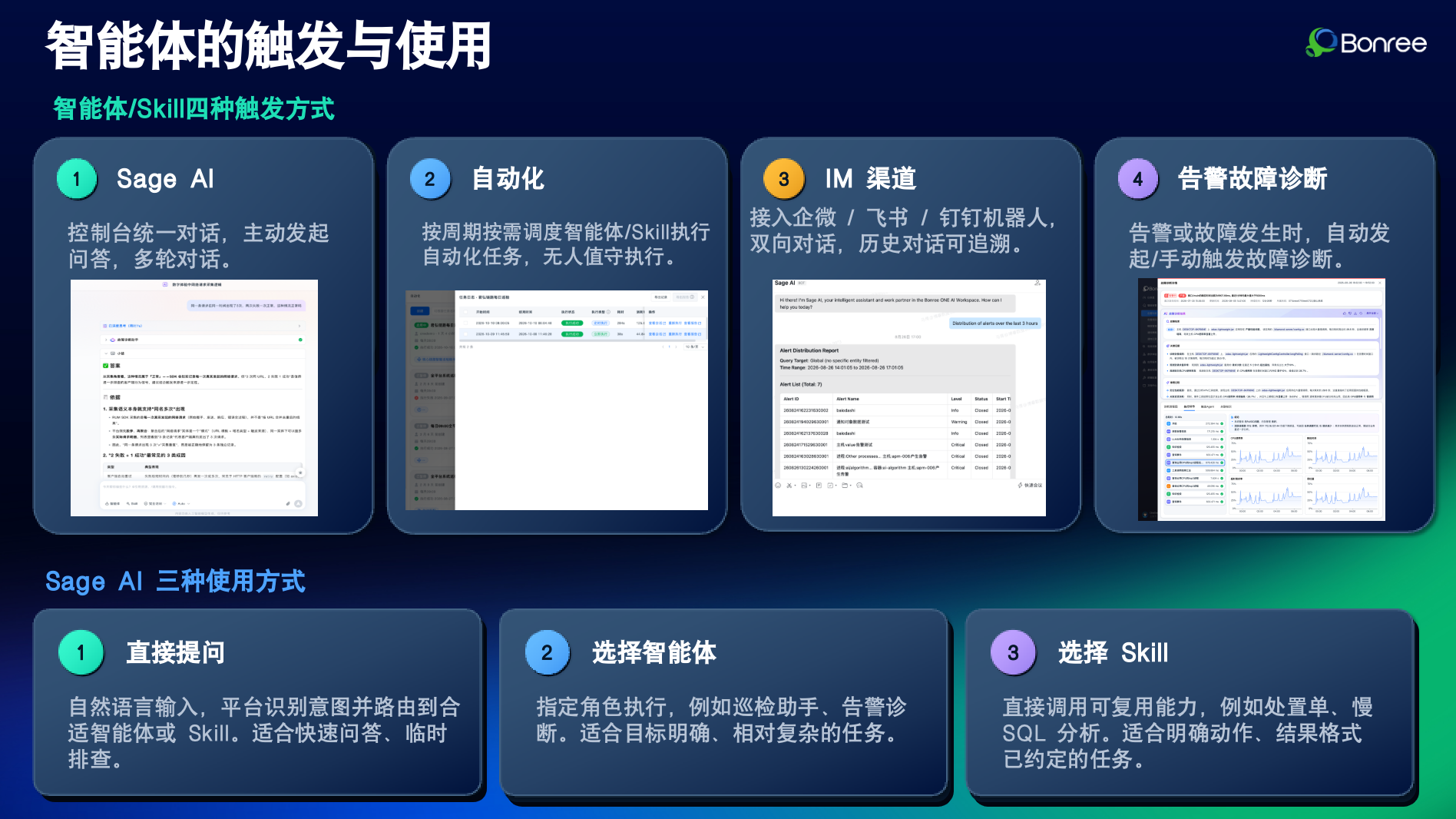
3. The Consumption Layer has four entry points: Bonree ONE · Sage AI (the unified intelligent interaction portal), Automation (scheduled task orchestration), IM channels (WeCom, Lark, and DingTalk bots), and the Alert List (the diagnosis entry point). Published agents are invoked by the business side here.
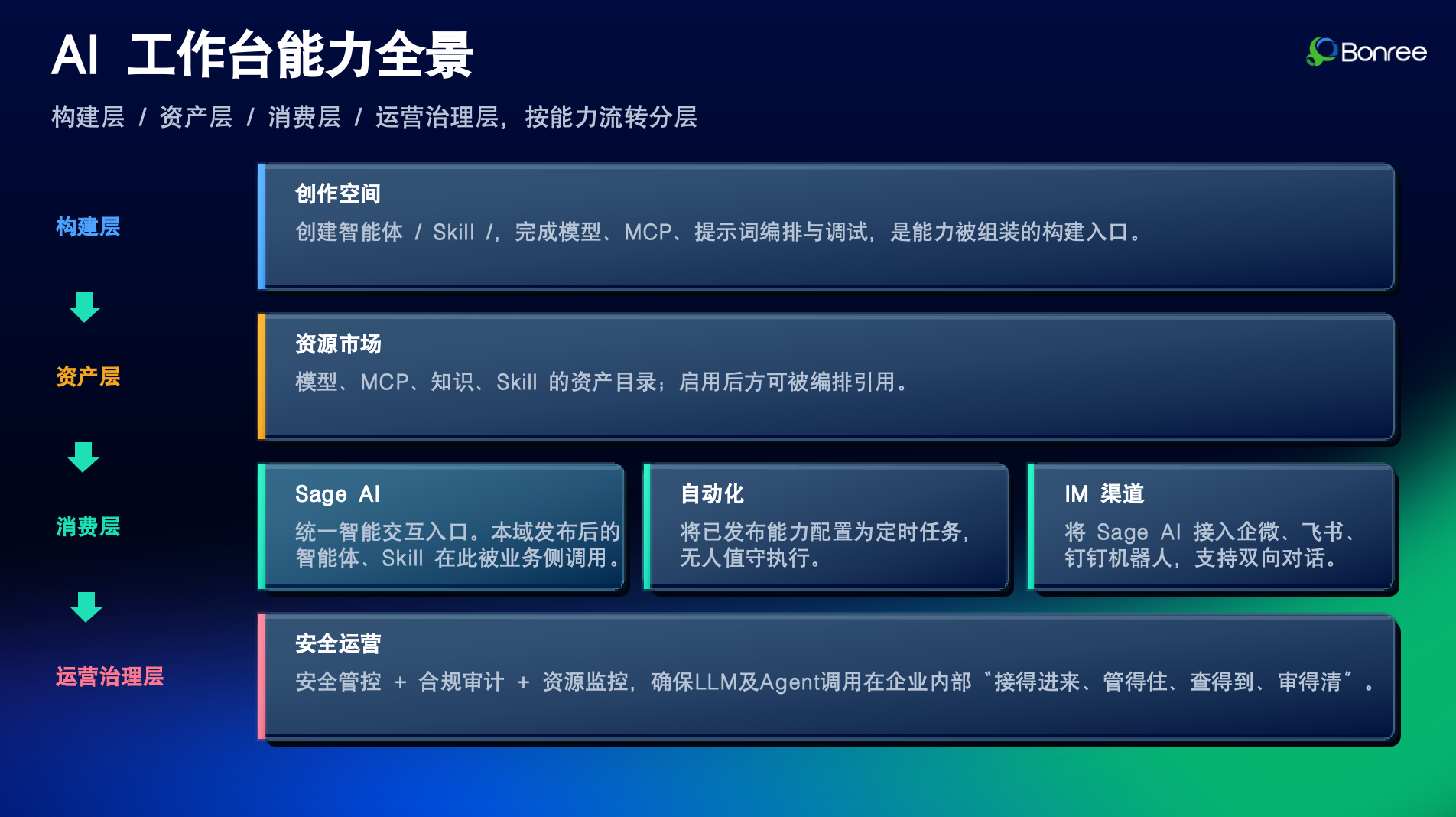
4. The Operations Governance Layer handles security control, compliance auditing, and resource monitoring, ensuring that LLM and agent calls inside the enterprise are connectable, controllable, traceable, and auditable.
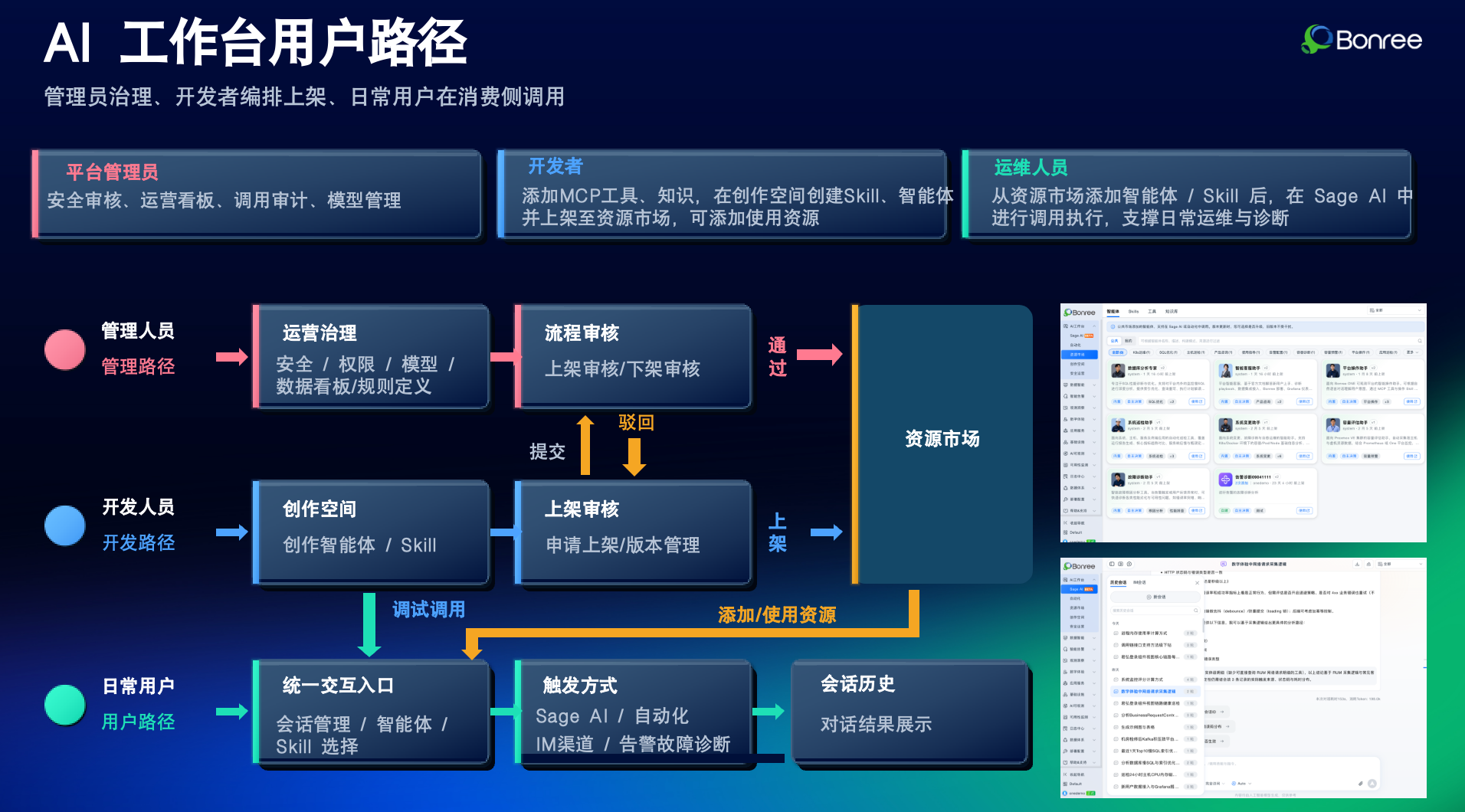
Developers incubate capabilities in the creation space; operations staff obtain ready-made assets from the resource marketplace; managers ensure security and compliance through the governance layer. The three roles each play their part, and everything converges into one agent consumption system.
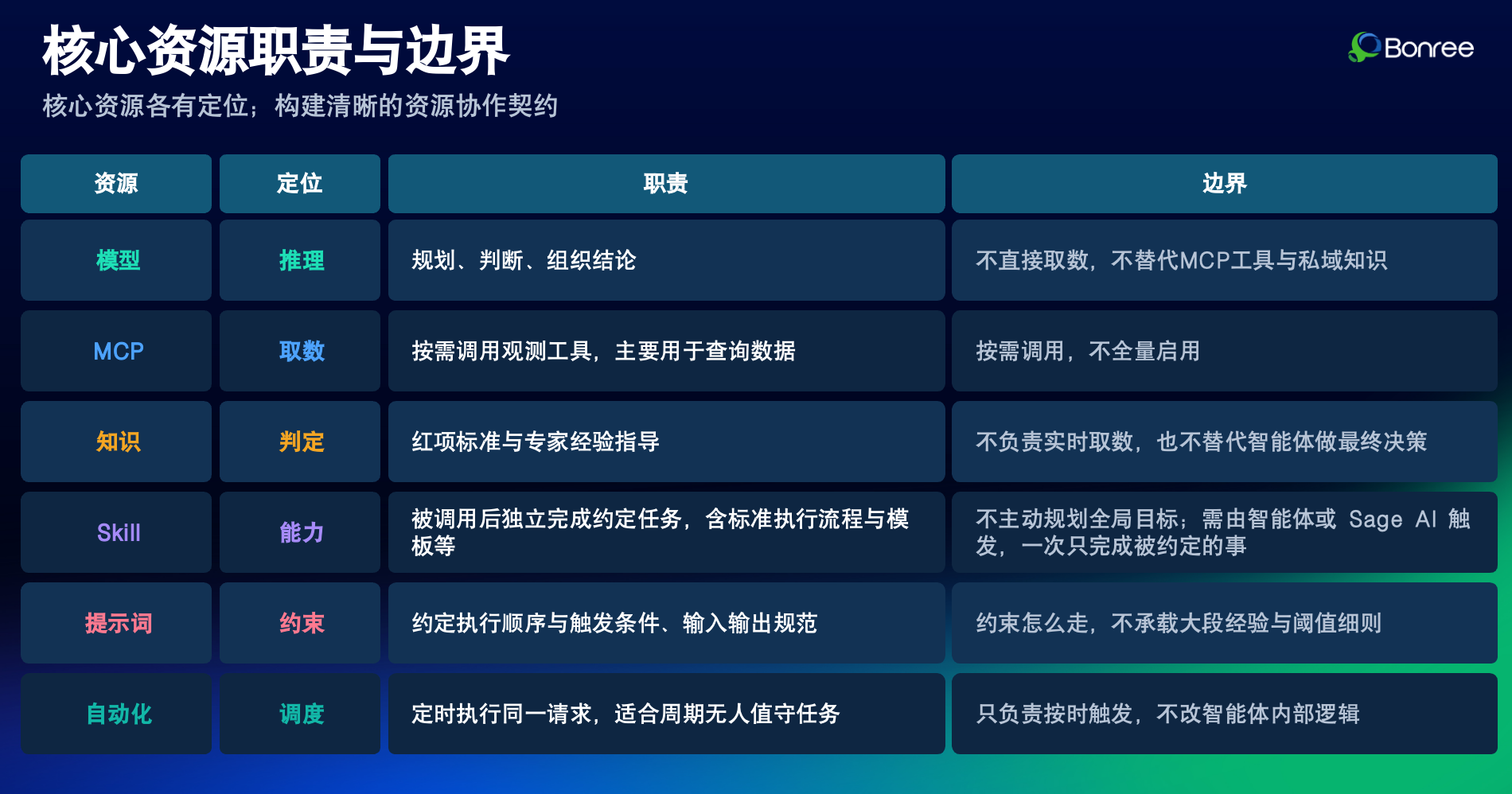
The Core Agent-Building Mechanism: Resource Orchestration Instead of Simple Q&A
Agent building in Bonree ONE · Sage AI differs from a simple chatbot. Its core is to orchestrate resources and encapsulate capabilities beyond the conversation itself. Three key points are worth understanding.
First, resource responsibilities and boundaries.
The model handles reasoning and planning, but does not fetch data directly. MCP fetches data on demand. Knowledge provides the judgment criteria. A Skill is an execution unit that completes a task independently. Prompts constrain execution order and trigger conditions. Automation handles scheduled dispatch. Each resource has its own role, forming a clear collaboration contract among resources.
Second, how agents and Skills collaborate.
The agent is like a restaurant manager: it plans and dispatches, and decides whether to fetch data, consult knowledge, or call a particular Skill. A Skill is like the standard recipe for a dish: it is only prepared when ordered, follows the recipe, and is plated to spec. The manager plans based on the request, calls the relevant Skill only when needed, and once the Skill finishes, the result returns to the agent for further decisions.
Third, two types of agents.
A Workflow agent advances through predefined nodes, which suits stable paths, clear steps, and processes that need strong control. An Autonomous Decision-Making agent lets the model plan the path and dispatch resources, which suits complex scenarios without a fixed path. Together, the two cover the two typical task forms in enterprises, and both are ultimately invoked in Bonree ONE · Sage AI.
Live Demo: Creating and Invoking the Database Call Inspection Expert
The scenario demonstrated was building a “Database Call Inspection Expert” agent. The inspection workflow follows a five-stage progressive framework: confirm the inspection targets and time range, take stock of the available data, run five checks in sequence, rank findings by impact, and output the inspection report. Each check has clearly defined criteria and threshold references.
In the Bonree ONE · Sage AI creation space, the developer completes the following in order: model readiness, knowledge and Skill preparation, agent creation, capability orchestration, and publishing and invocation. The whole process can be summarized in four stages: resource readiness → capability orchestration → publishing within the domain and listing → online invocation.
In actual use, the task description was very short: “Inspect database call activity over the last hour, and analyze anomalies and their causes.” Following the preset five-stage workflow, the agent automatically completed target confirmation, data inventory, the five checks, impact ranking, and report output. The entire analysis finished within 4 minutes, covered 14 database targets with call traffic, and quickly pinpointed two key risks.
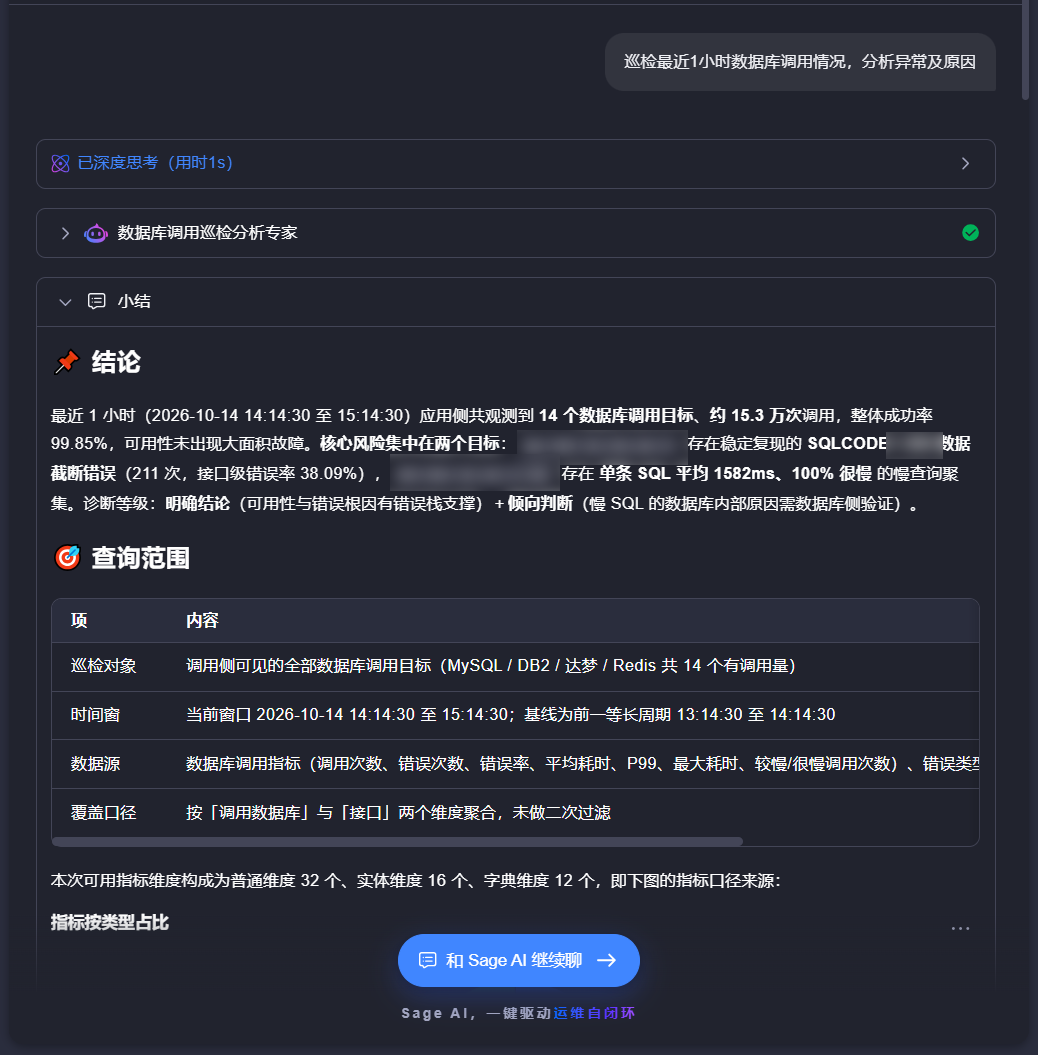
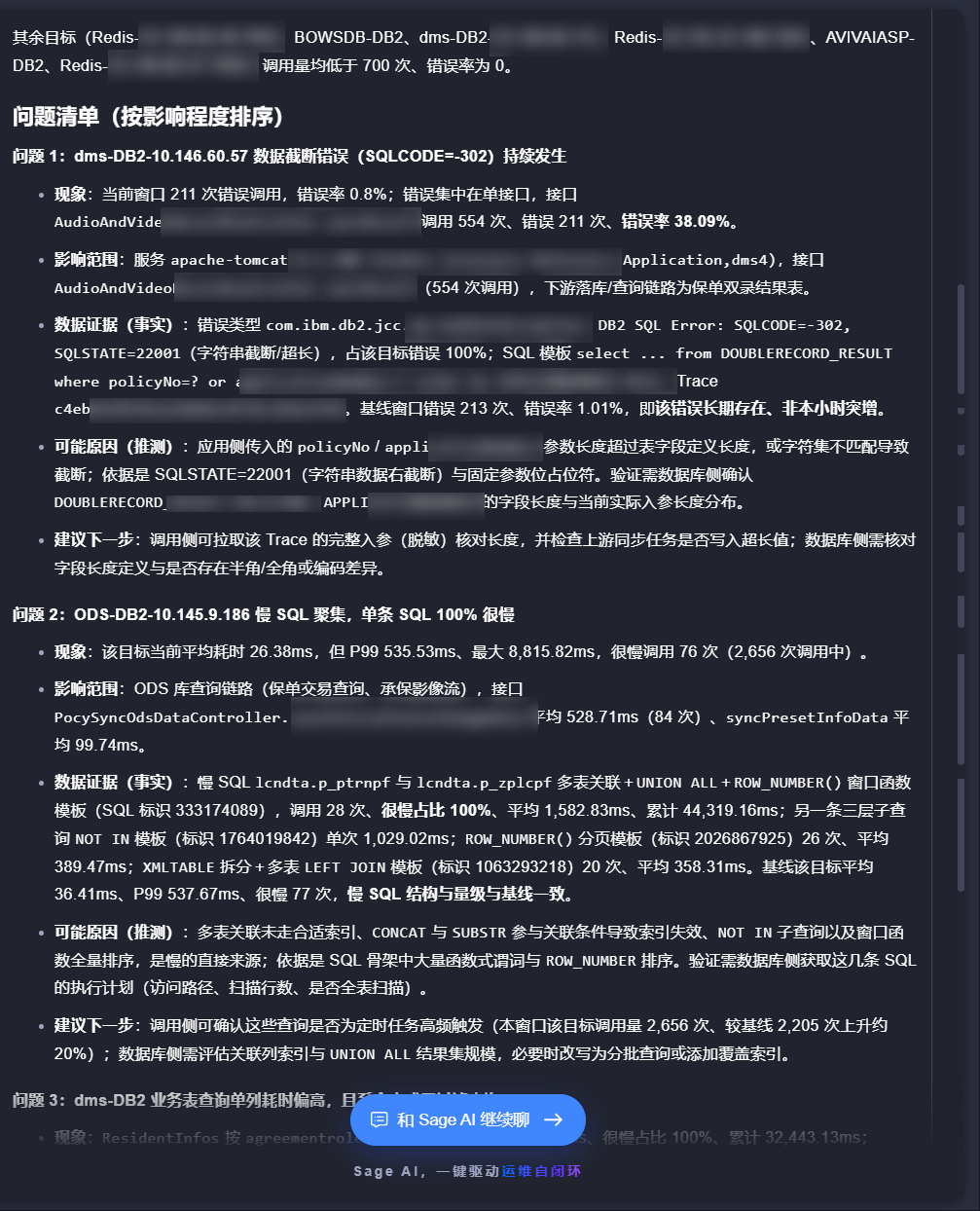
The first was a critical-level issue: a DB2 database showed a consistently reproducible data truncation error, with an interface-level error rate of 38.09% across 211 occurrences, concentrated in specific interfaces. The agent inferred that the root cause was either application-written data exceeding the defined column length, or a recent data model change that had not been adapted accordingly. It provided remediation advice for both the calling side and the database side. On the calling side: locate the triggering interface and SQL template, and verify the length of the incoming parameters. On the database side: confirm whether the target table’s column definitions were recently changed.
The second was a warning-level issue: an ODS database showed clustered slow queries, with a single SQL averaging 1,582 ms, a P99 of 535.53 ms, and a maximum of 8,815.82 ms. The agent inferred the root cause as missing indexes, stale statistics, or resource contention, and again proposed a coordinated plan for both sides. On the calling side: analyze the query pattern of the slow SQL template. On the database side: check index usage, statistics update times, and lock waits.
The report also explicitly labeled its diagnostic confidence: a definitive conclusion (availability and the root cause of the errors are backed by error stack traces) plus a leaning judgment (the internal database causes of the slow SQL require further verification on the database side). For each issue, it strictly separated “confirmed facts” from “inferences,” and gave next steps: “can continue to be verified on the calling side” and “requires verification with database-side data.” The report closes with data gaps and risk notes, candidly stating that its conclusions rely only on calling-side data.
Work that once took a senior DBA several hours, namely inspection comparison, issue localization, and report writing, now takes a single sentence. In 4 minutes, the agent delivered a complete, structured, standardized, and traceable analysis covering impact level classification, symptoms, scope of impact, supporting data, possible causes, and remediation plans.
Value Progression: From Individual Experience to Organizational Capability
The value of Bonree ONE · Sage AI lies not in adding one more chat entry point, but in changing how operations capabilities are produced. In the past, operations capability was attached to specific people. Now, capabilities can be decomposed, configured, published, and invoked. This brings three layers of progression:
First, from “experience leaves with the person” to “experience that accumulates.” A senior engineer’s inspection logic, judgment criteria, and output standards are fixed into the agent’s prompts, knowledge documents, and Skills, so staff turnover no longer causes them to be lost. For the first time, a team’s accumulated operations experience has a carrier that does not depend on any individual.
Second, from “one-off analysis” to “reusable capability.” Once built, an inspection agent can be called repeatedly by team members and reused in other scenarios, without starting from scratch each time. Capability production shifts from a handicraft workshop to a standardized assembly line, and marginal cost drops sharply.
Third, from “passive response” to “proactive coverage.” Agents can be triggered on demand or scheduled, and are online 24/7. When a failure occurs, the diagnosis entry point is always available. In daily inspections, coverage is no longer limited by headcount. People make decisions and serve as the safety net, while repetitive work goes to agents.
All of these changes point to the same result: the ceiling of an operations team’s capability is no longer set by headcount, but by its configurable, reusable, and schedulable agent assets. From building to consumption, from resources to assets, and from individual experience to organizational capability, Bonree ONE · Sage AI lets every enterprise build its own team of operations experts.