



How does Bonree ONE bring data from every corner of a heterogeneous IT estate into one observability practice, without forcing teams to hand-build a pipeline for every tool they already run? The answer lies in Bonree ONE's data integration capability, specifically its Custom Integration: rather than assuming every organization's toolchain looks the same, Bonree ONE gives teams a configurable path to bring open platforms, existing monitoring systems, and standard protocols into a single observability data layer, so no data source has to sit outside the platform's visibility.
Two Paths Into the Same Data Layer
Bonree ONE supports data integration through two complementary approaches. Standard Integration is a complete, out-of-the-box capability: the platform handles data processing for every category of observability signal and its association with the corresponding entities, and ships with best-practice metric models, entity models, alert rules, and dashboards already configured.
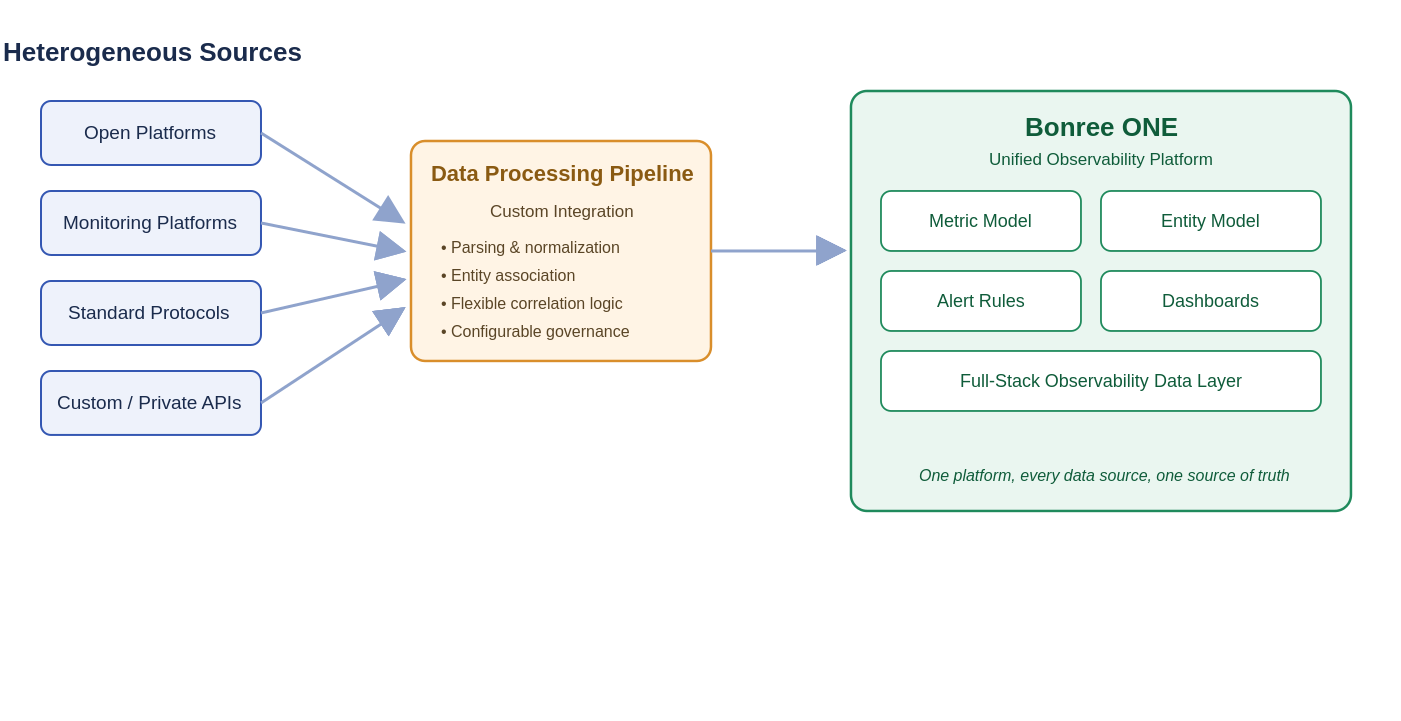
Custom Integration is designed for everything Standard Integration doesn't cover out of the box: open platforms, existing monitoring systems, and standard protocols that an organization already relies on. It provides the same foundational building blocks, data processing, metric models, alert rules, and dashboard best practices, but leaves room for teams to configure more complex data governance and entity association through flexible data processing pipelines.
Why Custom Integration Matters for Real-World Observability
Few enterprise environments run on a single, uniform stack. Most have accumulated open-source monitoring tools, vendor platforms, and protocol-based telemetry feeds over years of infrastructure growth. Asking every one of those sources to be replaced before an organization can adopt full-stack observability isn't realistic. Bonree ONE takes the opposite approach: it meets existing data sources where they are, connecting to open platforms, monitoring platforms, and standard protocols directly, so historical investment in tooling doesn't become a barrier to a unified observability practice.
Data Processing Pipelines: Governance Where It Gets Complex
Connecting a data source is only the first step. The harder problem is making that data mean something: mapping it to the right entities, aligning it with a consistent metric model, and ensuring it can be correlated with everything else already flowing through the platform. For straightforward cases, Custom Integration's built-in capabilities and best practices are enough. For more complex data governance and entity-association requirements, Bonree ONE's data processing pipelines can be flexibly configured, giving teams control over how raw signals from open platforms, monitoring platforms, and protocols are transformed, tagged, and related to the rest of the observability data model, rather than forcing every data source into a rigid, one-size-fits-all schema.
One Observability Data Layer, Not a Patchwork of Tools
The point of Custom Integration isn't just connectivity for its own sake. Once open platforms, monitoring platforms, and protocol-based sources are integrated, whether through Standard or Custom Integration, they all land in the same Bonree ONE data layer, governed by the same metric models, entity models, alert rules, and dashboards. That means teams get a single, coherent observability picture across their entire environment instead of a patchwork of dashboards that each only understand part of the estate.
FAQ
What's the difference between Standard Integration and Custom Integration in Bonree ONE?
Standard Integration is a complete, out-of-the-box capability covering data processing and entity association for common observability signals, along with ready-made metric models, entity models, alert rules, and dashboards. Custom Integration extends this to open platforms, monitoring platforms, and standard protocols, providing the same foundational capabilities while allowing more complex data governance and correlation needs to be configured through flexible data processing pipelines.
Does Custom Integration require replacing our existing monitoring tools?
No. Custom Integration is built specifically to connect to open platforms, monitoring platforms, and standard protocols that organizations already use, bringing their data into Bonree ONE's observability data layer rather than requiring a wholesale tooling replacement.
What happens when a data source needs more than basic integration?
For more complex data governance and entity-association requirements, Bonree ONE's data processing pipelines can be flexibly configured, giving teams fine-grained control over how incoming data is processed and related to the rest of the observability model.
Do custom-integrated sources get the same dashboards and alerting as built-in integrations?
Custom Integration comes with its own baseline of metric models, alert rules, and dashboard best practices, and because all integrated data lands in the same Bonree ONE data layer, teams can build a consistent observability view across both standard and custom data sources.